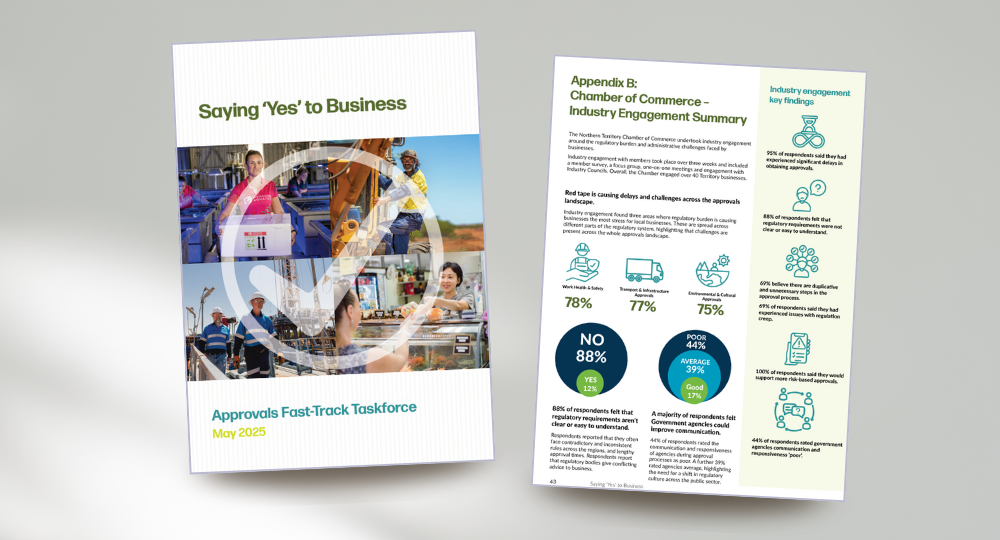
Saying "Yes" to Business - Approvals Fast Track Taskforce
July 2025
The Chamber of Commerce NT is proud to have played a key role in ensuring industry and business voices were heard in the work of the Approvals Fast Track Taskforce, which has now delivered its final report - Saying ‘Yes’ to Business.
The Approvals Fast Track Taskforce has delivered its final report, Saying ‘Yes’ to Business, with 70 recommended actions to simplify approval processes and remove barriers to investment in the Territory.Chief Minister Lia Finocchiaro said “The message is clear: the Territory is open for business. We are backing businesses to grow, invest and create jobs".
“Our government has fully accepted 60 of the Taskforce’s recommendations and accepted a further 10 in principle, in an aim to cut red tape and reduce approval delays by 50%.”
“These reforms will streamline processes, improve certainty for investors, and help build a stronger, more diversified economy,” Mrs Finocchiaro said.
View the main report and supplementary reports.
Background
The Approvals Fast-Track Taskforce was appointed by Chief Minister Lia Finocchiaro in November 2024 to provide expert advice on streamlining approvals and removing unnecessary and burdensome regulations.
The taskforce was comprised of industry experts from across the Territory to identify reforms that will benefit the greatest number of businesses, including small businesses across construction, hospitality, and agriculture and aquaculture sectors.
What's already underway
Significant changes have been already made:
- appointed a Territory Coordinator to identify key projects and fast-track statutory decisions
- removed third-party merits review for planning, water and petroleum regulation, maintaining community input while reducing costly delays.
The taskforce’s final report sets out a clear roadmap for applying a risk-based approach to regulation and fostering a regulatory culture that promotes business activity and certainty. It is built around 6 themes:
- modernising compliance requirements
- reducing unnecessary regulatory touchpoints
- enabling greater delegation and discretion
- increasing regulatory certainty
- driving system-wide improvements
- delivering effective regulatory stewardship.
These reforms particularly support small businesses in sectors such as construction, agriculture and hospitality.
Saying "Yes" to Business
Of the 70 recommended actions:
- 60 are fully accepted
- 10 are accepted in principle (recommended actions: 1B; 2G; 5A; 6C; 10A; 13; 19; 20; 22C; 22E)
- 2 are already completed
- 48 will be fast-tracked over the next 12 months (tranche 1)
- 12 will be progressed over 2 to 3 years (tranche 2)
- 8 require longer-term cultural and system reform (tranche 3).
Chamber of Commerce NT - Industry Engagement Summary
The Northern Territory Chamber of Commerce undertook industry engagement around the regulatory burden and administrative challenges faced by businesses.
Industry engagement with members took place over three weeks and included a member survey, a focus group, one-on-one meetings and engagement with Industry Councils. Overall, the Chamber engaged over 40 Territory businesses.
⫸ Red tape is causing delays and challenges across the approvals landscape.Industry engagement found three areas where regulatory burden is causing businesses the most stress for local businesses. These are spread across different parts of the regulatory system, highlighting that challenges are present across the whole approvals landscape.
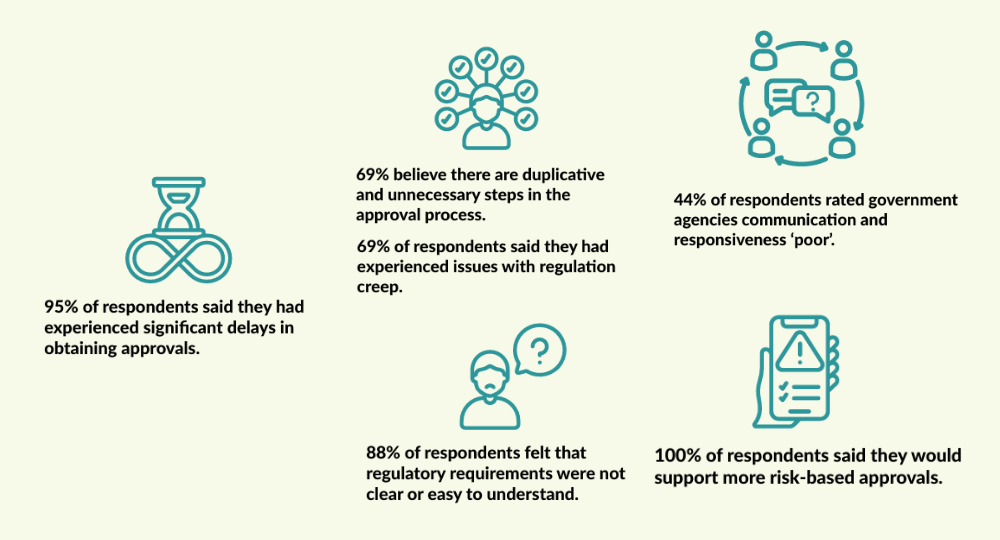
⫸ 88% of respondents felt that
regulatory requirements aren’t
clear or easy to understand.
Respondents reported that they often
face contradictory and inconsistent
rules across the regions, and lengthy
approval times. Respondents report
that regulatory bodies give conflicting
advice to business.
⫸ A majority of respondents felt Government agencies could improve communication.
44% of respondents rated the communication and responsiveness of agencies during approval processes as poor. A further 39% rated agencies average, highlighting the need for a shift in regulatory culture across the public sector.
⫸ Many businesses faced duplicative or unnecessary steps in the approvals process
Just over 69% of respondents have noted encountering duplicative or unnecessary steps in an approvals process. Common examples of confusion and duplication in processes included sending applications multiple times because requirements are unclear and overlapping requirements for different approvals processes.
⫸ 69% of respondents have experienced ‘regulation creep
69% of respondents have experience ‘regulation creep’, defined as when the approvals process becomes more complex over time due to incremental changes.
Examples included additional paperwork, longer processing times, involvement of multiple departments, higher costs and changing or unclear requirements.
⫸ Almost all of respondents have experienced significant delays in obtaining approvals
95% of respondents have experienced significant delays in obtaining approvals. Respondents provided examples including long delays from application processing timeframes and a time-consuming annual registration process. Respondents
also reported delays from assessment processes where there is a high volume of applications, causing the system to be overwhelmed.
Industry Engagement Key Findings